

♡ CALLING OFF THE WEDDING ♡
Or, how to break up with a manuscript

I have never been married, or even engaged. But I recently dropped a voice note in the chat with my literary agent that sounded a little something like this:
‘Hiiiiii, hope you’re well! I was just wondering if you could give me a call when you get to the office this morning. It’s nothing bad! Ha ha ha. Don’t worry. I mean, it’s not bad, but it’s… well, it’s kind of important. But also not. Maybe it’s fine. I think it’s actually like, medium-sized. Okay, chat soon! Bye.’
She called me right away, an anxious tremor in her voice as she assured me she was ‘Intrigued!’
I am a writer of various things. I often joke that I’ll write whatever someone will pay me (or promise to pay me, or not pay me at all) to do. I studied screenwriting in Australia, but upon graduating discovered just how hard it is to build a career in an industry that is mostly vapour. I wrote the odd article for newspapers, websites and one magazine, and then in 2020 – locked away in my rickety Melbourne sharehouse – decided to start a newsletter. This was before the proliferation of Substack as a way to communicate ideas in more than 280 characters, and so my understanding of ‘newsletter hosting’ was limited to MailChimp – a service my friends with jobs in marketing complained about all the time. I signed up for MailChimp and created my newsletter, which I called tall tales for reasons I cannot recall. I’m not even that tall (173 cm/5’8”).
For almost a year, I adhered to a diligent monthly email schedule. My audience was teeny tiny, encompassing friends, acquaintances, and maybe a few people who knew me because my friends were famous clowns. One morning, as I was preparing for another day manning the social media inbox of a luxury soap cult, I received a notification from MailChimp that someone with an email linked to a literary agency had subscribed to tall tales. I allowed myself approximately three minutes of excitement before beating my expectations into submission; it was probably nothing.
Around that same time, a friend of mine encouraged me to try my hand at writing a novel. I had an idea I’d been trying to sculpt into a TV pilot, but it wasn’t working out. My friend thought it would work well as a novel. I’ll skip over the boring stuff, but around the time I reached 40,000 words of the novel draft, I received a cold email from the agent. He wanted to know if I’d ever thought about writing a novel. I ran outside and sung Des’ree’s Life Oh Life at the top of my lungs, and then reminded myself – again – that it was probably nothing.
I ended up finishing the novel and signing with the agent. He was so incredibly patient with me – we worked through three and a bit drafts of the manuscript together before it was ready to go out on submission, which is to say he edited three and a bit drafts of the book for free. It was one of the kindest things anyone has ever done for me – the year and a half we spent working on that manuscript taught me how to write.
Fast forward to July of 2023, the book went out on submission and garnered enough interest to spark an auction for the AU/NZ rights, with a number of publishers offering to purchase a second book. But I, a mere mortal, had only written one book! So my agent said, ‘Have a think about what you might like to write, and get the pitch to me by tomorrow morning.’ I was in London, having a gay ol’ time eating sandwiches from the Dusty Knuckle and swimming in that dirty pond for ladies. I went to a cafe and dreamt up a ‘stylish sci-fi’ novel about a drama school where things are not entirely as they seem. By the end of the day, I was certain this idea would become my second novel. It was called The Method.
I started writing The Method in earnest in February of 2024. I was at a surf camp in Sri Lanka with my sister and about twenty-five Swedish girls. It was exciting, wading into a new story, armed with everything I’d learned while writing Rytual – my first novel, due out the following May. I was completely obsessed with the Apple TV+ series Severance, and had the idea that I could write something in the same tonal world, set in Australia, about a group of actors and also a malevolent tech company. Every time I tried to explain it to someone, they stared back at me with glassy confusion in their eyes, but assured me it sounded, ‘Really interesting!’ This only caused me to become more tongue-tied.
The first draft of The Method took me one year and one month to finish, but when I say ‘first draft’ I really mean draft zero, because it was completely unreadable to anyone but me. About halfway through, I found myself totally consumed by the AI debate, and manoeuvred the story towards the notion that in order to make robots more human, we will inevitably make humans more robotic. I had little bursts of excitement for the project, but when I look back now it’s clear I was in over my head – my first novel was a campy erotic thriller about a cult beauty brand that turns out to be a real cult. I often said I wanted to write things that were ‘somewhat smart, somewhat stupid’, and yet there I was, drafting a sci-fi novel in third person because I thought all serious books existed in the space just above the characters’ heads.
The initial deadline for The Method was June of 2025, but in April – when I’d finished my draft zero – I knew I needed more time. I asked my agent, who asked my publisher, who said, ‘take as much time as you need’, and then asked the contracts department to draft an addendum that extended the deadline to August. I signed the addendum and went back to my laptop, all the while promoting my first novel, which was published in May. Confused? I was! I would not recommend that schedule to anyone. Writing and promoting a book are two different jobs.
After my Australian book tour, I returned to Los Angeles, where I’d been living for the six months before my novel’s release. My first book wasn’t published in the US, so I was an unknown entity in LA – something I thought would fuel my productivity upon my return. Actually, what happened was that I got really depressed! Hooray!!!! I’m told it’s normal, particularly after the release of your first book, but I must admit I also made the misguided decision to go off my antidepressants while promoting my first book and……. yeeeeeeeeeeah, I would not recommend that either.
I had just over a month to rework my draft zero into something I could hand to my publisher, a whip-smart, foul-mouthed British woman I absolutely adore, and whose opinion means a great deal to me. I chained myself to my desk, the communal table at the local coffee shop, basically any surface I could open my laptop on, and got down to business. Despite implementing all of the changes I’d predicted would fix the story’s ills, it seemed that every time I patched a hole, another one sprung forth from a totally unexpected place. I remember admitting to a friend that the story felt like it was constantly slipping through my fingers. We were strutting around the Silver Lake Reservoir, her two dogs in-tow. She swore that everyone felt that way about their works in progress. ‘It sounds great,’ she said, with a reassuring lilt, but one of her dogs was about to eat another dog’s poop for the second time that morning, so she wasn’t exactly all ears.
I finished the draft with a week to spare, and ended up handing it in two days early. I didn’t know what else to do with it, particularly with only forty-eight hours left on the clock. It took my publisher over a month to read it and get back to me, and although she said she loved it, her notes boiled down to ‘I think you should start again’. The notes were astute, generous and delivered with kindness, but even the most stoic among us would have to admit, the prospect of a page one re-write absolutely blows.
Here are the biggest elements she (and my agent) suggested I change:
Shift the POV from third to first person (to a non-writer this probably sounds straightforward, but this in itself is a page one re-write)
Change the setting from Perth to Los Angeles. My publisher said something along the lines of, ‘I don’t want to force you to do anything you don’t want to do, but you’ve written a book about actors and an American tech company, and you’ve set it in Perth. Meanwhile, you live in LA… Hmmmm.’
Cut half the supporting characters
There were chatbot transcripts in the original draft, which they suggested I get rid of
My publisher closed her editorial letter by saying she understood the new draft would require a lot of work, but that she believed I could do it. Also, in order to remain on-schedule, was there any chance I could have the revised version back to her in three and a half months? I said, ‘Of course!!!’ and went on my merry way, not allowing myself to get bogged down by the size of the task, or the incessant tick-tick-ticking of the looming deadline.
I hated every second of working on that re-write.
Not because of the notes! The notes were beautiful! Intelligent! Insightful and, most importantly, correct! The problem wasn’t the direction the book was going in, the problem was that I’d fallen out of love with the book entirely. In November, I found myself googling ‘does everyone hate their second book reddit’ once a week. I couldn’t imagine what the cover would look like, or what I’d say about it in interviews. But I pressed on – I’d received half the advance for The Method at that point, and it felt like the only way out was through. I started to wonder if I was falling out of love with writing in general, but then I enrolled in a screenplay intensive and wrote a feature film about Martha Stewart’s time under house arrest, which brought me a stupid amount of joy every time I opened the file in Final Draft. In fact, I was more productive in that three and a half month period than I had been in years, all in an attempt to avoid the manuscript. I wrote the feature film, I wrote a pilot with an actor friend, I planned and executed a launch party for the B-format version of Rytual, I wrote a column for a magazine and performed a piece at a comedy storytelling night. And, miraculously, I also finished the re-write.
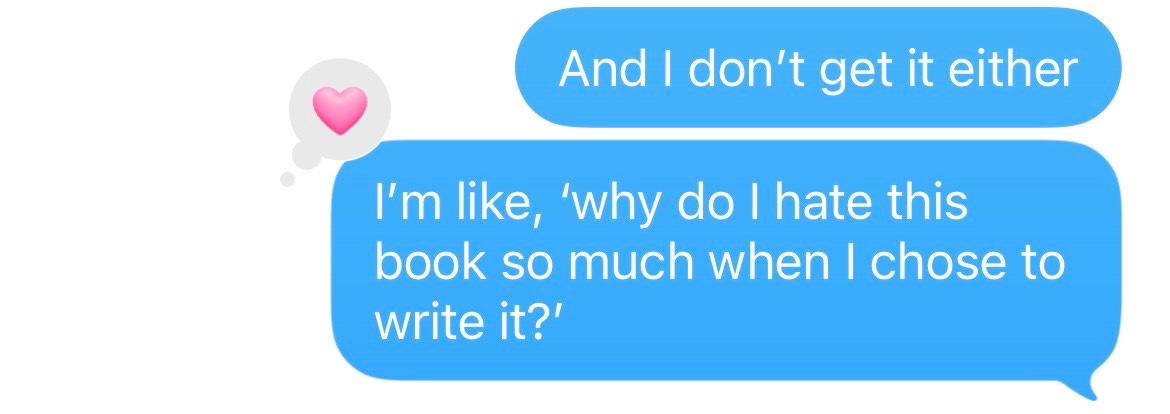
But the only thing worse than writing the new draft was editing it. I spent a week and a half combing through bloated, boring scenes before I really started to panic. I vowed to take a break from writing novels after this one was published – ‘It’s too much work!’ – but then again, I just couldn’t see it going ahead. ‘Maybe they won’t even want it?’ I said to another author, my voice dripping with hope. She assured me it’d have to be markedly worse than the last draft for them to pull the pin, and even then – they’d already given me the money. Surely that meant they were serious about it.
At this point, I should have just called my agent and told her how I was feeling (I forgot to mention that my first agent became a million-copy bestselling author and quit his job just after my deals were signed). Instead, I forced myself to continue editing. One night, I was so worked up about how bad the book was, I put myself in the shower like you would a drunk girl with vomit in her hair. It was there, beneath the flow of lukewarm water – I was back in Australia and it was the middle of January – that I communed with the gods. Whatever Elizabeth Gilbert said about ideas and creativity and eating, praying, loving… it was that. Not whatever she did last year that made everyone mad.
The solution was so simple, I couldn’t believe it took me that long to do the math: I would take my two favourite characters from The Method and give them an entire book to themselves. No sci-fi. Nothing high concept to speak of. I’d recently re-watched All About Eve and Sunset Boulevard, and I’d spent a year living just off the real Sunset Boulevard – I wanted to write a hazy, Hollywood Golden Age kind of story, set in the present-day, about unfamous women and famous men and purpose and obsession. With heaps of jokes. That it had jokes in it was incredibly important to me.
The next morning, I sent my agent that kookoolookoo voice note, and proceeded to breathlessly outline the new book to her over the phone, start to finish. I have never felt more like ‘the talent’ in my life. We made a plan for pitching it to my publisher, who ultimately agreed to take it on instead of The Method. ‘Why would I want to force an author to publish a book she hates?’ My publisher said, which is a great point! I wish I’d said something to her sooner.
In total, I spent almost two years working on The Method. I used to hear stories of authors finishing manuscripts only to have them die on submission, or be rejected by their publisher, and gasp. All that work, down the drain. What a huge disappointment. In my experience, abandoning my second novel was nothing short of exhilarating. The unpleasant experience of writing it, and re-writing it, and re-writing it, taught me so much about the craft of writing. It reminded me that joy is the thing. It’s the whole thing. It’s work, sure, but if joy doesn’t live there, what are you hanging around for??? Also, serious novels don’t have to be in third person. And novels don’t have to be serious. I dare you to abandon the book you hate; I dare you to call off the wedding.
Does setting your old book in Perth mean you’re from there? That’s where I’m from! Would’ve frothed reading the original in that setting 😄. Well done cutting ties w it tho and doing the brave thing!
Loved reading this, I am currently trying to write a novel and just started the draft from the beginning in first person. I thought the same that it couldn’t be serious and also first person, all Serious Literature seems to be third person. This has given me hope